
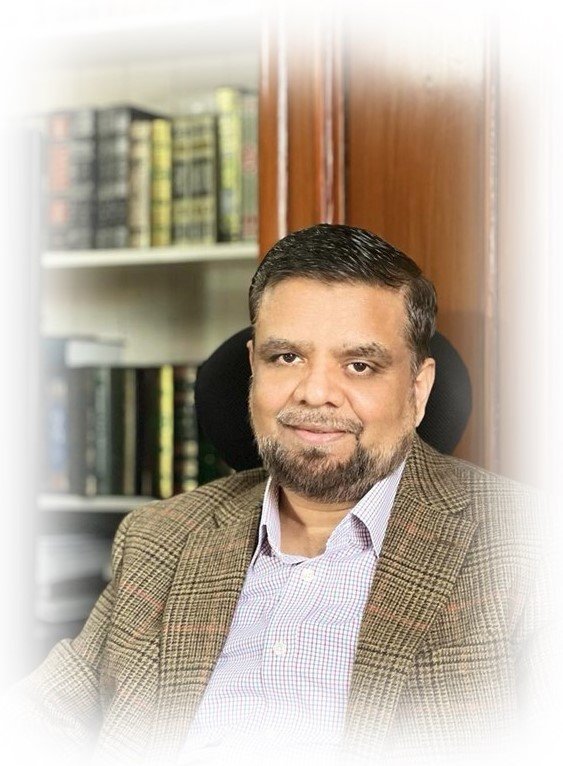
 Dr Mahfooz Jawed Nadvi, born and raised in India, began his academic journey
at Nadwatul Ulama, Lucknow, India where he graduated in Islamic Shari’ah in 1990. He then moved to the UK to study Economics, earning a PhD in Islamic Economics from the University of Glasgow in 1996. To further enhance his skill set, he later completed post-graduate studies in Information Technology at the University of the West of Scotland (formerly known as the University of Paisley).
Dr Mahfooz Jawed Nadvi, born and raised in India, began his academic journey
at Nadwatul Ulama, Lucknow, India where he graduated in Islamic Shari’ah in 1990. He then moved to the UK to study Economics, earning a PhD in Islamic Economics from the University of Glasgow in 1996. To further enhance his skill set, he later completed post-graduate studies in Information Technology at the University of the West of Scotland (formerly known as the University of Paisley).
His career started with the Halal Mutual Investment Fund in Scotland, where the Royal Bank of Scotland acted as the custodian. Dr Jawed Nadvi played a key role in ensuring the fund's Shari’ah compliance and operational integrity. In the late 1990s, he relocated to the Middle East, where he worked with leading Islamic financial institutions like the Algosaibi Group in Bahrain and Al-Rajhi Bank in Saudi Arabia. During this time, he contributed significantly to the development of structured finance products and Shari’ah-compliant asset origination.
Dr Jawed Nadvi later moved to London, where he joined the Dawnay, Day Group, working on the Middle East desk in the Commodity Murabaha department, dealing with the London Metal Exchange (LME). He was responsible for asset management and structuring Shari’ah-compliant solutions for various Islamic banks and financial institutions across the Middle East.
He was a key player in the design of Islamic credit and debit cards for several banks in Saudi Arabia and Bahrain and was involved in setting up the Islamic Bank of Britain (now Rayan Bank), the first Islamic bank in the UK.
Previously, he taught at the Bahrain Institute of Banking & Finance, University of Bahrain, and the University of Glasgow, UK.
Currently based in Glasgow, Dr Jawed Nadvi runs his own consulting company, advising Islamic financial institutions globally on Shari’ah-compliant products development.
Beyond Islamic finance, Dr Jawed Nadvi is a founding member of the Foundation for Social Care in Lucknow, India, which runs colleges in medicine, nursing, pharmacy, and management, as well as Hayat Hospital and several schools.
Dr Jawed Nadvi also writes Urdu allegorical fiction and has been recognised by academic institutions for his literary contributions.
His main area of expertise, however, is Islamic banking and finance, and he has written extensively on many contemporary and forward-looking aspects of the field. Some of his key papers are listed below. If you're interested in any of his papers, please get in touch.
Analysing the challenges Islamic finance faces in integrating into the global economy, including regulatory and cultural barriers.
A critical examination of how Islamic economic principles compare to Western welfare systems in terms of redistributing wealth and promoting social welfare.
Examining the development and structure of Islamic alternatives to conventional financial derivatives such as swaps and options.
Analysing how Sukuk are priced differently from conventional bonds due to the prohibition of interest (riba) in Islamic finance.
Investigating tools and methods for hedging financial risks within the bounds of Islamic law, including tahawwut (Islamic hedging) and its practical applications.
A technical exploration of how commodity Murabaha contracts are structured and used in Islamic banking to facilitate liquidity while adhering to Shariah.
Analysing how Islamic contracts such as Salam (advance purchase) and Istisna (manufacturing & construction contract) can serve as Shariah-compliant alternatives to forward contracts in conventional finance.
Comparing the risk-return profiles of Shariah-compliant equity funds with conventional funds using statistical techniques.
Investigating the compliance of Islamic principles in the trading of commodities in spot markets and futures contracts, focusing on Shariah-approved structures.
Exploring the structure and pricing differences between Ijarah Sukuk (Islamic leasing bonds) and conventional leasing bonds, and their appeal to global investors.
An exploration of how complex financial products, such as hybrid instruments and Islamic financial derivatives, are developed and engineered within Shariah-compliant frameworks.
Exploring how Islamic banks manage liquidity risk through Shariah-compliant central bank instruments and interbank markets.
A detailed technical study on the structure and application of Tawarruq in Islamic finance and the controversies surrounding its use for liquidity management.
Examining how Arbun, a form of earnest money, can be used to create Shariah-compliant options as an alternative to conventional derivatives.
Comparing the risk and return profiles of Shariah-compliant credit cards with conventional credit cards, focusing on consumer credit risks and bank profitability.
Investigating the potential for algorithmic and high-frequency trading in Islamic stock markets and whether these practices align with Shariah principles.
A technical exploration of Shariah-compliant mutual funds, focusing on risk management, asset allocation, and diversification strategies.
A technical analysis of the challenges Islamic banks face in non-Muslim majority countries, including regulatory hurdles, compliance with Western financial laws, and cultural adoption.
Exploring how digital banking, fintech, and blockchain technologies are expected to shape the future of Islamic banking in the Middle East.
A technical analysis of how Islamic financial institutions can use commodities from the LME for Shariah-compliant hedging, particularly using Murabaha and Salam contracts.
A technical analysis of how Shariah-compliant equities are screened and traded on NASDAQ, with a focus on financial ratios, revenue sources, and sector exclusions.
Analysing the LSE’s role in promoting Islamic finance by listing Shariah-compliant instruments like Sukuk and Islamic ETFs, and addressing regulatory challenges.
A comparative analysis of Islamic indices like the NASDAQ Shariah Index and the LSE's Shariah-compliant indices, evaluating their performance, market growth, and investor interest.
A forward-looking study on the development and application of Shariah-compliant risk management tools such as Islamic futures, swaps, and derivatives to handle volatility in global financial markets.
Exploring how Islamic economic principles have evolved from the time of the Prophet Muhammad (PBUH) to the present day.
University of Glasgow, UK, 1996
© 2024. Al Qalam Academy, Glasgow, UK. All rights reserved.